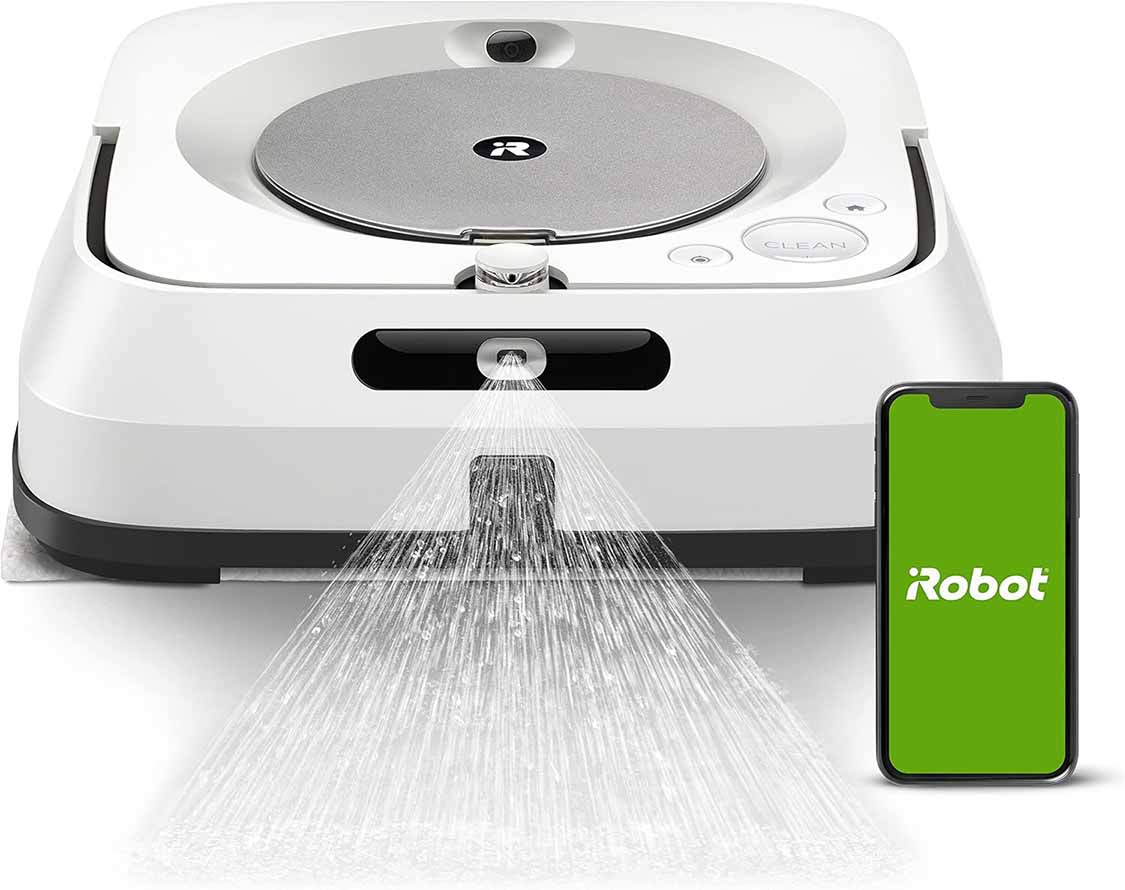
iRobot Braava Jet M6 Review
A Smart Robot Mop That's More Limited Than It Looks
Jade Stevens
February 3, 2026 · 5 min read
Quick Verdict
The iRobot Braava Jet M6 is a dedicated robot mop — not a vacuum — and it was genuinely impressive when it launched. Its Imprint Smart Mapping, precise zone-based cleaning, and seamless pairing with compatible Roomba vacuums set a high standard for the category. But the M6 is showing its age, and its fundamental design limitations have become harder to overlook as the market has evolved. The flat mop pad applies fixed, light pressure and cannot concentrate scrubbing force on a single stubborn spot. The water tank is small. Floor-level transitions trip it up. And perhaps most damaging to its value case: modern 2-in-1 robot vacuums now vacuum and mop in a single pass with self-cleaning docks, eliminating the need to run two separate devices at all. The M6 still does what it does quietly and intelligently, but what it does is increasingly narrow.
Overall Score
Understanding What the M6 Actually Is
Before evaluating the M6, it’s worth being clear about its nature, because the “robot mop” category can be easily misunderstood. The Braava Jet M6 is not a vacuum cleaner that also mops. It is a mopping and dry-sweeping device only. Dry sweeping mode uses an electrostatic pad to capture dust and hair from hard floors — think of it as an automated Swiffer, not a vacuum. Wet mopping mode sprays a small jet of water ahead of the pad and wipes the floor as it passes.
This means that if you own an M6 and want your floors comprehensively clean, you still need a separate robot vacuum to actually pick up debris, pet hair, and particles before mopping. iRobot’s Imprint Link technology makes this workflow elegant if you pair the M6 with a compatible Roomba: the vacuum cleans first and, when it’s done, automatically signals the M6 to start mopping. For iRobot ecosystem households, this tandem operation is genuinely well-designed. For everyone else, owning two robots to do what one 2-in-1 device now handles is a harder case to make.
Mapping and Navigation: The M6’s Strongest Asset
Where the M6 genuinely shines is its Imprint Smart Mapping system. The robot builds detailed multi-room maps of your home, stores them, and allows you to specify exactly which rooms or zones to mop and when. You can tell it to clean only the kitchen, only in front of the stove and sink, or only the bathroom — all from the app or via voice commands through Alexa or Google Assistant.
This precision is the M6’s most differentiating feature and it works very well. The navigation is described by Consumer Reports as “very good,” and real-world user experience generally backs that up for straightforward home layouts. The robot cleans in methodical rows, returns to base when the battery is low and resumes where it left off, and the iRobot app is one of the most intuitive and well-designed in the robot vacuum category — far cleaner and easier to navigate than apps from many Chinese manufacturers.
The Imprint Link pairing with compatible Roombas is, for the right user, one of the more clever product integrations in the home automation space. After the vacuum finishes, the M6 starts automatically. No manual intervention required.
The Mopping Limitation: Fixed Pressure, Flat Pad
Here is the central problem with the M6, and it is one that cannot be solved by firmware updates. The mop pad is flat, attached directly to the robot’s underside, and applies whatever pressure the robot’s body weight provides. There is no mechanism to vary that pressure, concentrate it, or scrub in a rotational motion.
For light daily maintenance — keeping already-clean floors clean, removing surface dust and footprints — this is fine. The flat pad does exactly what you’d expect. The trouble starts when the mess is more serious. Dried juice, tracked-in grime, greasy kitchen splatters, pet paw prints with mud: these require scrubbing force that the M6 simply cannot generate. Multiple reviewers report following the M6 around with a spray bottle of floor cleaner to pre-wet stubborn spots, because the robot’s own Precision Jet Spray does not deliver enough moisture to loosen anything properly dried. At that point, the automation advantage is largely lost.
In contrast, modern 2-in-1 robot vacuums like the Dreame L10s Pro Ultra Heat and eufy S1 Pro use spinning or rolling mop systems that apply meaningful downward pressure while rotating, making them considerably more effective at removing dried-on messes. These are not direct comparisons since they also vacuum, but they illustrate how the mopping technology landscape has moved.
Threshold and Floor-Level Transitions
The M6 is particularly vulnerable to floor-level changes. Even small transitions between rooms — a door track, a slight raised lip between tile and hardwood, a thin rug edge — can stop it or cause it to get stuck. One reviewer documented the robot repeatedly failing to re-enter the kitchen after leaving it, because the minimal junction between flooring types was just enough to prevent the flat mop pad from clearing. A redesign that allowed the mop to raise and lower dynamically would address this; no such feature exists.
This means the M6 works best in homes with flush floor transitions throughout, which in practice limits it primarily to newer construction or single-surface homes. Older homes with varied flooring, different tile heights between rooms, or thick door bars will find the M6 needing regular rescues from stuck positions.
Maintenance: Pads and Solutions Add Up
The M6 uses proprietary mop pads in two types: disposable (single-use) and washable (reusable). The disposable pads are convenient but generate ongoing waste and cost. The reusable washable pads are the more sensible long-term choice, but they require regular laundering and replacement over time. iRobot’s own cleaning solution is recommended for best results, adding another recurring purchase.
Multiple reviewers noted that the disposable pads in wet mode can cause streaking, while the washable pads tend to perform more cleanly. Some users also reported that the water tank, while adequate for a single room, requires refilling when mopping a larger open-plan space. This is manageable but does require periodic intervention that undercuts the fully-autonomous promise.
The Value Question in 2026
When the M6 launched, the idea of a smart robot that would automatically mop your floors after your Roomba vacuumed them was genuinely exciting. In 2026, the more relevant question is: why run two robots when one can do the job?
2-in-1 robot vacuums have improved dramatically. Models like the eufy X10 Pro Omni, the Dreame L10s Ultra Gen 2, and others combine vacuuming and mopping in a single device, with self-cleaning docks that wash the mop pads automatically. They are not perfect substitutes for the M6’s dedicated mopping ability in all scenarios, but for most households they handle both tasks well enough to eliminate the need for a separate dedicated mop robot.
Pros
- Imprint Smart Mapping enables room-by-room and zone-specific mopping
- Imprint Link pairs with compatible Roombas to mop automatically after vacuuming
- Precision Jet Spray loosens dried-on messes before mopping
- Very quiet operation — easily runs at night or during work calls
- Excellent app with intuitive controls, scheduling, and smart home triggers
- Compact design with premium build quality typical of iRobot products
Cons
- Vacuum-only at heart — dry sweeping pad is no substitute for a real robot vacuum
- No spinning or scrubbing mop pad mechanism — flat pad with fixed pressure only
- Struggles with anything beyond light maintenance mopping
- Small water tank means frequent refilling in larger homes
- Cannot handle even small floor-level transitions without getting stuck
- Ongoing pad and solution costs add up over time
- Considerably outpaced by 2-in-1 robot vacuums that vacuum and mop together
Who Should Still Consider the M6?
The M6 makes the most sense in a specific and narrowing set of circumstances. If you are already an iRobot household with a compatible Roomba and you value the seamless Imprint Link tandem cleaning workflow, the M6 is the best-integrated option for adding dedicated mopping to that setup. iRobot’s ecosystem, app, and reliability record are genuinely good, and the paired vacuum-then-mop sequence works very smoothly.
If you primarily need daily light maintenance mopping on smooth tile or hardwood in a home with flush floor transitions, the M6 is quiet, precise, and good at exactly that task. And if you have reasons to prefer keeping your vacuum and mop functions completely separate — including concerns about a 2-in-1’s mop mechanism getting wet debris on carpet or the cleaning solution contaminating the vacuum’s dustbin — there is still a logic to a dedicated mop robot.
The M6 makes sense if:
- You own a compatible iRobot Roomba and want the tandem vacuum-then-mop workflow
- Your floors are smooth, flush, and need only light maintenance mopping
- You prefer a dedicated, quiet mopping device rather than a 2-in-1
Think carefully before buying if:
- You do not already own a compatible Roomba
- Your home has any floor-level transitions or door tracks
- You expect to tackle dried-on or stubborn messes regularly
- Your budget could stretch to a 2-in-1 that vacuums and mops in one pass
The iRobot Braava Jet M6 is not a bad product. It is a product that was designed for a world before 2-in-1 robot vacuums became as capable as they now are. For existing iRobot households with the right home layout, it still earns its place. For new buyers, the case for purchasing a separate dedicated mop robot has become a difficult one to make.